
Nuclear at China Speed: An interview with François Moran
While the world stands poised for a nuclear renaissance, China has already been going at it. How can we learn from China's fast buildout and what could be in the future of the Chinese atom?

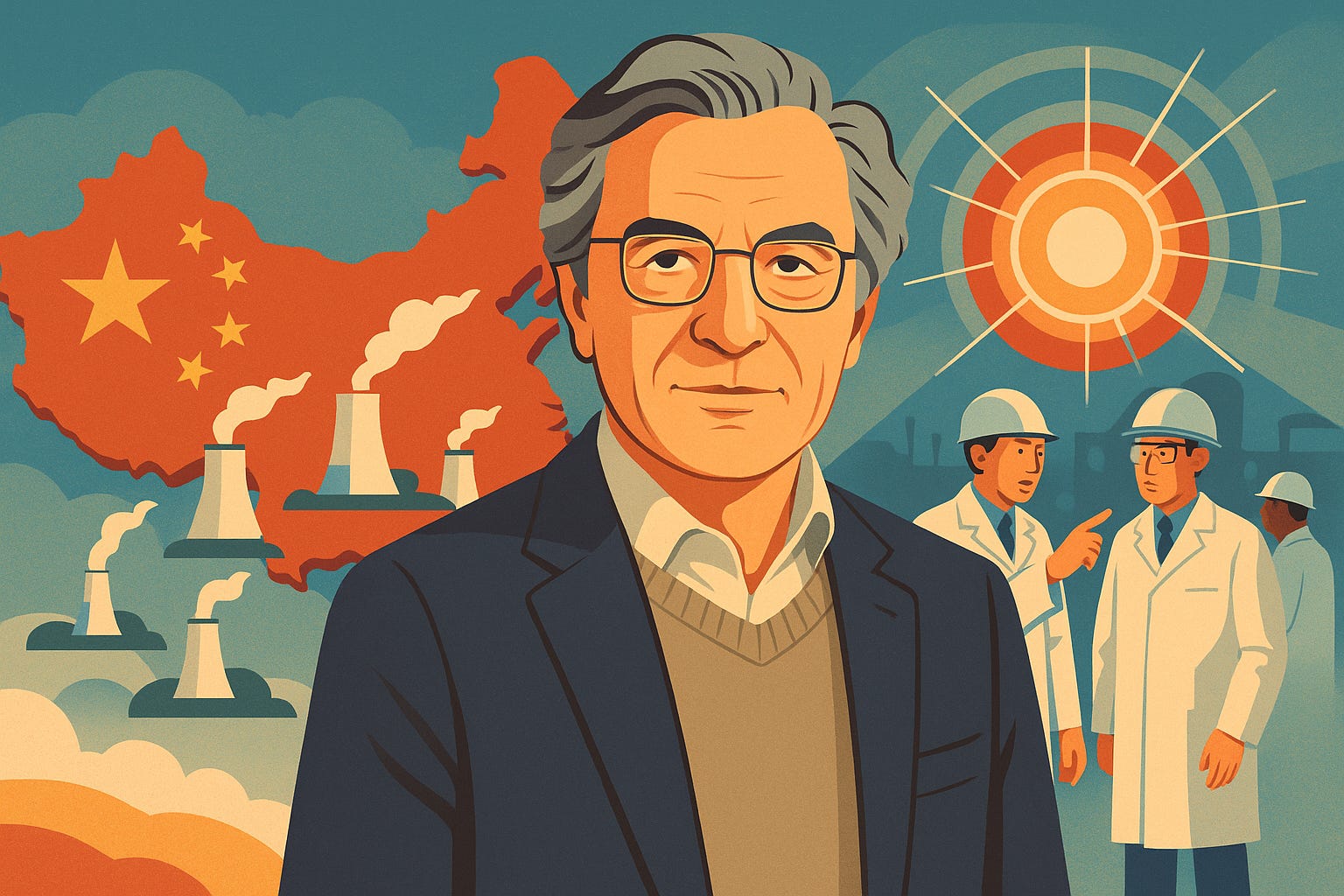
When I was asked to go on TP Huang’s China Tech Talk to talk about Chinese nuclear development, I knew I had to phone a friend first. That friend is François Moran, the World Nuclear Association’s man in China and a repository not just of deep knowledge but wisdom about the Chinese atom and beyond.
We had a immersive and wide-ranging conversation and I want to capture as much of it for you as possible. But here is the takeaway up front: nuclear is going forward in China at what seems like a dizzying pace to us. But that pace you’re seeing is simply “China Speed.” And when you compare nuclear’s “China Speed” with other technology also proceeding in China, you’ll realize that Chinese nuclear is kind of the slow kid in the class.
Bien sûr there are reasons for this which François and I will unpack below, but also expore the bright points and how atomic energy can further progress from the modest role it now play in China’s energy systems.
Uranium Availability: a point of long-term anxiety
YOU might not be worried about uranium availability but China is. “The goal they have set is to have one third of the uranium they need produced domestically, another third from foreign but Chinese-owned mining operations, and the final third from the global market. But in reality, they are having problem satisfying even 15% of their demand domestically,” François said.
Despite being poised for a breakout for years now, Uranium remains cheap as chips. It’s difficult from our point of view in 2025 to imagine a shortage. The World Nuclear Association itself envisages no difficulties until 2040.
“But what about 2045? 2050? 2075? Are we not supposed to be tripling nuclear globally? How does that work with the uranium supply we have even if we just keep the current capacity?”
There is almost certainly a lot more uranium in the ground we haven’t explored. In fact, China itself announced a huge discovery last year. What is not known is the ore grade of the mine and whether it will be worth it to dig up (or leach up) all that rock to recover the yellow stuff. As for seawater extraction? “A science experiment,” so far.
That Thorium Reactor in the Gobi Desert
Everybody is excited about the Thorium Molten Salt Reactor (TMSR) project in the Gobi desert. One of the reason why the Chinese are keen on developing Thorium is because of their Uranium anxiety. But as François notes, the Chinese are exploring any number of advanced technologies and the TMSR is just one.
The approache is reminiscent to how the Chinese got started with nuclear power in the first place: They pretty much built one of everything from every vendor they can find before setting on the Hualong (based on a French reactor but extensively modified) as their workhorse reactor.
So. What is going on in the Gobi desert? The TMSR they have operational right now is called LF-1, a research reactor producing 2MW thermal only. There was great fanfare in April this year when it was announced they successfully added thorium fuel to the TMSR-LF1 and that a 10MW electric pilot is planned with a 2030 goal completion date.
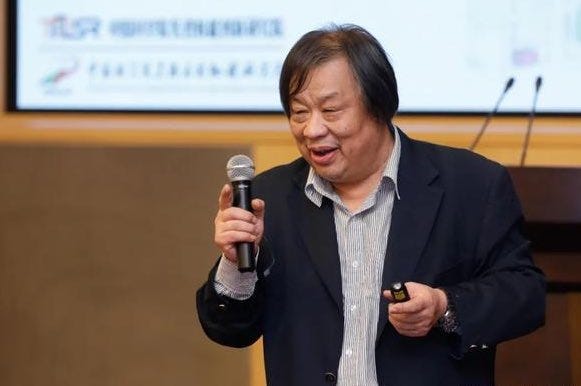
Professor Xu Hongjie, the project lead of the TMSR program, was able to celebrate the success of loading fresh Thorium fuel and share his excitement about the future of the program in June at a talk. “We chose the hardest path, but the right one,” said Xu, adding that he had high hopes for China to disrupt the global energy market.
Unfortunately Professor Xu passed suddenly from an unexpected heart attack in September in Shanghai. His 400 colleagues in the program will undoubtedly carry on his work.
“It is very important to remember that the LF-1 is still a research reactor. It’s job is to be a test bed to solve problems, and a lot of those problems are still not solved,” noted François.
One is the removal of Protactinium fission products from the salt, which is required for the continued operation of the reactor. “Until that process is figured out, then they cannot truly start to work on the 10MWe reactor,” noted François. It’s 2025 now, which means the 2030 timeline will be tight.
More than one way to save Uranium: China’s Breeder Reactors
Another great way to relieve Uranium anxiety is by getting more electricity out of the same amount of fuel. This is what the Russians have been pioneering with their breeder reactors and the Chinese have been following suit. For now, the Chinese are still using Russian-made fuel, but they will doubtlessly the be figuring out their own way around the reprocessing of spent fuel in the future.
Right now, the CFR-600 or the Xiapu Fast Reactor Pilot Project sits on Chiangbiao Island in Fujian province, right across the Taiwan straits where I am writing this post in a cafe in Taipei. The first unit 600MWe is operating well, and should be joined by a 2nd soon. The plan is to go every bigger once all kinks are ironed out with a giga-watt scale CFR-1000.
Small to go big, not small for its own sake
François noted making a visit to see the Chinese SMR ACP-100, affectionately known as Ling Long 1 (meaning “petite dragon”). It’s sited at the Changjiang Nuclear Power Station, where it sits next to a couple of Gigawatt-scaled Hualong Ones.
If you stand at just the right angle, said François, you can indeed see that the Ling Long building is slightly smaller. But let’s just say the difference is…subtle. It is still a big honking building. But unlike the slightly bigger honking building of the Hualong next door, the Ling Long is producing a tenth of the energy.
“The best case scenario is to probably use it in barges like the Russian,” said François. Building reactors small for small’s sake is definitely not the Chinese approach. In fact, with site scarcity a real bottleneck, the Chinese are trying to gain efficiency by maxing it out by building their reactors bigger and bigger. (A reminder that this was also once the approache in the west.)
“Modularity hits a limit,” notes François.
Running fast to fall behind: Nuclear’s continued modest contribution to the Chinese grid
Despite what looks like a breakneck buildout in China, grid penetration of nuclear energy in China remain around 5% because the rest of the grid is growing so damned fast!
“Do not have the expectation that nuclear will take over from the fossils in China. Instead, it is forging its own modest path,” said François. Not what I loved to hear.
What about Team Low-carbon altogether? Isn’t China also spamming solar farms and somehow making even offshore wind as cheap as cabbabes?
“The average solar panel only provides valuable energy for 1hr 17 minutes a day,” said François. So why are people still building them? In a way, it is the same logic as China’s infamous Ghost Cities. Developers don’t own the land outright, and they have to develop it in order to retain the rights. Solar farms are an inexpensive way of doing this, with the additional benefit that a useless solar farm looks the same as a productive one, unlike apartment buildings.
As for how much solar the Chinese grid could productively absorb, concievably it could be quite high. It is the only country to have invested in an Ultra High Voltage grid that can send solar power from Gansu to Shanghai. But that infrastructure comes at a price. According to François just the cost of transport for that MWh could be equivalent to just sourcing nearby nuclear.
Coastal hopes, inland indecision
Some coastal provinces have high nuclear penetration! In prosperous Guangdong province, for instance, nuclear accounts for 16 percent of the grid. Many of those coastal provinces are as big as countries elsewhere.
What’s really hurting China’s ability to max out on nuclear are regulators’ post-Fukushima heebie jeebies about putting nuclear plants near inland rivers. There were extensive plans to site nuclear power plants inland before Fukushima. And while François have been predicting they will be revived anytime now for years, that felicitous day has not yet come.
Always remember river floods caused a lot of trauma for China historically. Imagine a Fukushima-style accident that caused irradiated water all the way down the river used to irrigate China’s breadbasket?
Nevertheless, as confidence in safety improves and post-Fukushima adjustments are completed, François still think China’s inland nuclear potential will be unlocked.
“The regulators here are tough and they do their job, but always in a collaborative way,” said François. Although for 10 project the National Council greenlights each year, the National Nuclear Safety Administration (NNSA) might only hand out licenses for five.
Is Fusion the future?
In 2021 Commonwealth Fusion rocked the fusion world with their use of a material called “REBCO” to produce a superconductor with a incredibly strong magnetic field.
Fusion is hard because you need the coldest of ice producing a magnetic field hugging the fieriest of flames. A material that give you a stronger magnetic field could be worth quite something. Dare we say fusion is always 10 years away now instead of 20?
What is Rebco? It stands for Rare Earth Boron Copper Oxide. The rare earth usually used is Yttrium, the plain potato of rare earths. Nope, China can’t hoard this one all to themselves. But that does not mean the Chinese doesn’t have a hidden advantage anyhow.
“The thing about the Chinese is they have really mastered the processing of the rare earth elements. It could be that they can use their edge to produce Yttrium at a higher purity than western teams can obtain.”
There are two main Chinese fusion projects working on Rebco. One is associated with state-run CNNC and the other, named Energy Singularity, is privately-held. They will be going head-to-head with Western fusion ventures such as Commonwealth, and at this point its anybody’s game.
The Belt and the Road
It is a fact universally acknowledged that once the Chinese perfect a product, then it must be in want of an export market for that product. So how are the Chinese NPPs doing on the world market?
Not quite selling like hot cakes. The thing is, they are against some formidable competition in the form of the Russians.
“The Chinese are capable builders, but a nuclear reactor sale is not just a piece of equipment,” said François, “the Russians take care of the after-sales service to a different level, even to the reprocessing of the fuel.”
However, the fact that Kazakhstan ordered two Hualong units — the first ever belt-and-road related reactor sale! — could be a sign of things to come.
THE ELEMENTAL TAKE
China is large. She contains multitudes. And as impatient and excited as nuclear fans are by what appears to be stunning progress, we must also accept that for China, atomic energy is just a small part of her priorities. More great things will undoubtedly come, but patience is required.
In the meantime, let’s take a look at what the United States have been contributing to the Nuclear Renaissance.
Crazy fortunes are being made on the back of powerpoint decks in the west right now. Nuclear is hot hot hot I can’t deny it. Maybe it’s not too late to get into Oklo. If not, anybody know of any new ventures going public via SPAC?
But sky-high valuations and Wall Street buzz don’t build reactors. And unbuilt reactors don’t power data centers.